
Yesterday I highlighted the inadequacies and assumptions in the scenarios which form the input for Global Climate Models (GCMs). Today, I'd like to pinpoint the inadequacies of the GCMs themselves. The key point to appreciate about most computer simulations in science is that they rarely simulate all the relevant processes involved in the system under study. For all but the simplest of systems, it is necessary to parameterise various things. The behaviour and effect of parameterised processes and objects is not simulated, merely set by hand. The parameters represent the average or approximate effect of the things which cannot be simulated.
Simulation methodology requires that one validates a simulation by testing that it is capable of reproducing known data as output. In the case of a GCM, validation requires the simulation to reproduce the known global temperature profile up to the present day for the known profile of CO2 and SO2 emissions. However, there is a methodological problem here which besets many scientific simulations: the setting of the simulation parameters (a process called calibration) has to occur at the same time as validation. One adjusts the values of the parameters until the simulation reproduces the desired output. There is an obvious problem here: if the underlying logic of the model is incorrect, that fact can be concealed during calibration by adjusting the simulation parameters until the combination of parameter values compensates for the inaccuracy of the underlying model, and the desired output is obtained. To reduce the probability of this, one needs to calibrate a simulation against a number of different scenarios; one needs to obtain a fixed combination of parameter values which are such that the simulation reproduces actual data across a range of different scenarios. It is less likely that a specific choice of parameter values could compensate for inadequacies in the simulation model across a range of different scenarios.
However, for GCMs, there is a big problem here: there is only one set of data to validate and calibrate against; GCMs can only be calibrated and validated against 20th century climate data. This means that GCMs cannot be properly calibrated and validated until the parameterised processes are de-parameterised, and properly simulated. In the case of GCMs, the parameterised processes are typically things like cloud cover formation, which have a significant effect on global temperature, but which lie below the resolution level of the simulations. Sure enough, the various GCMs used by the various climatological research institutions around the world produce a large range of different predictions for the global temperature profile in the 21st century.
There is an even more severe problem with the validation and calibration of GCMs against 20th century climate data: not one of the models is capable of accurately reproducing the temperature profile throughout the 20th century. The 20th century basically divides into three phases from a global climate point of view: there was a period of rapid warming, but negligible CO2 emissions between 1900 and 1940; a period of global cooling from 1940 until 1975 despite significant increases in CO2 emissions; and a second period of significant warming from 1975 until the end of the century, in concert with a significant increase in CO2 emissions. The GCMs are capable of reproducing the temperature profile from 1975 onwards, but they tend to struggle with the temperature behaviour prior to that. One can postulate that the cooling from 1940 to 1975 occurred because several volcanic eruptions pumped SO2 into the atmosphere, and this had a cooling effect. However, the rapid temperature increase in the first part of the century, without a corresponding increase in CO2 emissions, is difficult for the GCMs to explain. Perhaps the best explanation is that patterns of solar radiation, such as sunspot cycles, were responsible for this temperature increase. If so, however, then one must acknowledge that current variations in global temperatures are a function of both solar radiation and CO2 emissions.
Tuesday, January 30, 2007


Monday, January 29, 2007
Global climate change and the IPCC
On Friday of this week, the Intergovernmental Panel on Climate Change (IPCC) releases the first part of its fourth report. Like the previous IPCC reports in 1990, 1996 and 2001, this document will attempt to assimilate and distill all the climate-change research done over the previous 5 years or so, and to produce a number of 'headline' statements intended to influence international political policy-makers.
Of particular interest is the predicted effect of CO2 emissions upon global temperatures by 2100. The IPCC obtains a predicted temperature range by taking the output from a number of different Global Climate Model (GCM) supercomputer simulations, conducted by various climate research institutions across the world. Whilst the 2001 report predicted a global temperature increase of 1.4-5.8°C by 2100, the New Scientist article suggests that the new predicted temperature increase will be 2.0-4.5°C. However, I am very interested to find out the specifics which underlie this prediction.
The range of the temperature uncertainty here comes both from the range of different GCMs, and the range of different emission scenarios which are input into the models. The global temperature profile over the 21st century which a GCM outputs, depends upon the 'scenarios' input into the simulation, and the fidelity of the simulation model itself. The future CO2 emission profile, (and that of the other greenhouse gases), and the sulphate emission profile, largely define a scenario. The simulation scenarios which obtained a temperature increase above 2.5°C in the 2001 IPCC report tended to assume (i) that CO2 emissions would rise by 1% each year, and that (ii) SO2 (sulphate) emissions would drop off significantly beyond 2030. See, for example, the SRES A2 scenario.
A number of critical points were made about these scenarios in Bjorn Lomborg's book, 'The Skeptical Environmentalist', and these same points raise questions about the 2007 report:
Sulphates are thought to have a cooling effect on the Earth, but because they are associated with pollution, it is assumed that legislation will remove this cooling effect beyond 2030. If it is now assumed in the 2007 scenarios that sulphate emissions will be reduced earlier, then the GCMs will predict higher temperature increases for this reason.
Actual CO2 emissions have been rising by about 0.4% throughout the 1980s and 1990s, so if this rate of increase were to continue, it follows that the 2001 IPCC scenarios greatly over-estimated the amount of global warming. However, I read now that CO2 emissions have increased by 3% over the past 5 years, which is approximately a 0.6% annual increase. This, perhaps, is a consequence of Chinese economic growth. I would like to know what CO2 increases have been assumed in the current IPCC report, and whether those assumptions can be justified by global economic projections.
The price of solar power is decreasing by 50% per decade, and, if this continues, solar power will be a competitive alternative to fossil fuels by 2030-2040. Whilst the IPCC scenario referred to as the A1T scenario does incorporate a transition to renewable energy sources circa 2040, the IPCC scenarios which generate the highest predicted temperature increases fail to take this into account.
It was noticeable in the 2001 IPCC reports that the effect of changing from one simulation model to another had a greater effect upon the projected temperature increase than the effect of changing the input scenario for a fixed simulation model. As Lomborg put it, the 'noise' created by the various simulations is greater than the strength of the signal. This casts significant doubt upon the reliability of the global climate models which underpin the IPCC reports.
The IPCC chairman, R.K. Pachauri says "I hope this report will shock people and governments into taking more serious action." My worry, however, is that the scientific understanding and data is being manipulated to meet this pre-conceived requirement. It may well be necessary to exaggerate the severity of anthropogenic global warming in order to galvanise governments into action, but the long-term consequence may be that the credibility of scientists becomes eroded in the public conscience.
Of particular interest is the predicted effect of CO2 emissions upon global temperatures by 2100. The IPCC obtains a predicted temperature range by taking the output from a number of different Global Climate Model (GCM) supercomputer simulations, conducted by various climate research institutions across the world. Whilst the 2001 report predicted a global temperature increase of 1.4-5.8°C by 2100, the New Scientist article suggests that the new predicted temperature increase will be 2.0-4.5°C. However, I am very interested to find out the specifics which underlie this prediction.
The range of the temperature uncertainty here comes both from the range of different GCMs, and the range of different emission scenarios which are input into the models. The global temperature profile over the 21st century which a GCM outputs, depends upon the 'scenarios' input into the simulation, and the fidelity of the simulation model itself. The future CO2 emission profile, (and that of the other greenhouse gases), and the sulphate emission profile, largely define a scenario. The simulation scenarios which obtained a temperature increase above 2.5°C in the 2001 IPCC report tended to assume (i) that CO2 emissions would rise by 1% each year, and that (ii) SO2 (sulphate) emissions would drop off significantly beyond 2030. See, for example, the SRES A2 scenario.

A number of critical points were made about these scenarios in Bjorn Lomborg's book, 'The Skeptical Environmentalist', and these same points raise questions about the 2007 report:
Sulphates are thought to have a cooling effect on the Earth, but because they are associated with pollution, it is assumed that legislation will remove this cooling effect beyond 2030. If it is now assumed in the 2007 scenarios that sulphate emissions will be reduced earlier, then the GCMs will predict higher temperature increases for this reason.
Actual CO2 emissions have been rising by about 0.4% throughout the 1980s and 1990s, so if this rate of increase were to continue, it follows that the 2001 IPCC scenarios greatly over-estimated the amount of global warming. However, I read now that CO2 emissions have increased by 3% over the past 5 years, which is approximately a 0.6% annual increase. This, perhaps, is a consequence of Chinese economic growth. I would like to know what CO2 increases have been assumed in the current IPCC report, and whether those assumptions can be justified by global economic projections.
The price of solar power is decreasing by 50% per decade, and, if this continues, solar power will be a competitive alternative to fossil fuels by 2030-2040. Whilst the IPCC scenario referred to as the A1T scenario does incorporate a transition to renewable energy sources circa 2040, the IPCC scenarios which generate the highest predicted temperature increases fail to take this into account.
It was noticeable in the 2001 IPCC reports that the effect of changing from one simulation model to another had a greater effect upon the projected temperature increase than the effect of changing the input scenario for a fixed simulation model. As Lomborg put it, the 'noise' created by the various simulations is greater than the strength of the signal. This casts significant doubt upon the reliability of the global climate models which underpin the IPCC reports.
The IPCC chairman, R.K. Pachauri says "I hope this report will shock people and governments into taking more serious action." My worry, however, is that the scientific understanding and data is being manipulated to meet this pre-conceived requirement. It may well be necessary to exaggerate the severity of anthropogenic global warming in order to galvanise governments into action, but the long-term consequence may be that the credibility of scientists becomes eroded in the public conscience.
Sunday, January 28, 2007
Quantum constructor theory
I'm off to Oxford this Thursday to see David Deutsch's talk on 'Quantum constructor theory', users.ox.ac.uk/~ppox/general/seminar.html (4:30pm, 10 Merton St, for those interested in popping along). Deutsch, of course, is the inventor of quantum computing, an advocate of the many-worlds interpretation of quantum theory, and a chap with some interesting thoughts on the relationship between physics, mathematics, and computation. Deutsch gives some hints about what quantum constructor theory might be in this interview at Edge.org (www.edge.org/3rd_culture/deutsch/deutsch_index.html):
What sorts of computations do physical processes correspond to; which of these 'computations' can be arranged with what resources? And which sorts can't be arranged at all? What little we know about this new subject consists of a few broad limitations such as the finiteness of the speed of light. The theory of computability and complexity theory give us more detail on the quantum side. But a big technological question in my field at the moment is, can useful quantum computers actually be built? The basic laws of physics seem to permit them. We can design them in theory. We know what physical operations they would have to perform. But there is still room for doubt about whether one can build them out of actual atoms and make them work in a useful way. Some people are still pessimistic about that, but either way, that debate is not really a scientific one at the moment, because there is no scientific theory about what can and can't be built. Similar questions are raised by the whole range of nanotechnology that has been proposed in principle. So that's where a quantum constructor theory is needed.
What sorts of computations do physical processes correspond to; which of these 'computations' can be arranged with what resources? And which sorts can't be arranged at all? What little we know about this new subject consists of a few broad limitations such as the finiteness of the speed of light. The theory of computability and complexity theory give us more detail on the quantum side. But a big technological question in my field at the moment is, can useful quantum computers actually be built? The basic laws of physics seem to permit them. We can design them in theory. We know what physical operations they would have to perform. But there is still room for doubt about whether one can build them out of actual atoms and make them work in a useful way. Some people are still pessimistic about that, but either way, that debate is not really a scientific one at the moment, because there is no scientific theory about what can and can't be built. Similar questions are raised by the whole range of nanotechnology that has been proposed in principle. So that's where a quantum constructor theory is needed.
Saturday, January 27, 2007
Hurrah! 'Top Gear' is back!
Probably the best TV programme in the world, 'Top Gear' returns on BBC2 this Sunday evening. Needless to say, the programme also marks the return of Richard Hammond, critically injured last September when the jet-powered car he was driving suffered a tyre failure at just below 300mph.
 Whilst ostensibly a TV programme about cars, Top Gear metamorphed some years ago into a general entertainment and comedy show. In this respect, it approaches TV perfection. The mix of items is superb, switching from car-tests, to news features, to stunts, to the 'star-in-the-reasonably-priced-car', and to the latest competitive challenge posed to the co-presenters, Jeremy Clarkson, James May, and Richard Hammond. The chemistry of the co-presenters is perfect, and Clarkson's sardonic wit is fashionable again now that people have tired of gliberal politics. The quality of the filming and editing is fantastic, with clever and imaginative use of filters and lenses and location. As Clarkson pointed out in the following article,
driving.timesonline.co.uk/article/0,,22749-2372412_1,00.html
"the average shooting ratio for a modern television programme is about 20 to one. In other words, you shoot 20 minutes of tape for every one minute that makes it to the screen. Top Gear works on a ratio of 250 to one. Top Gear, and I’m not bragging because this part has nothing to do with me, is probably the best-made programme in the world."
 Whilst ostensibly a TV programme about cars, Top Gear metamorphed some years ago into a general entertainment and comedy show. In this respect, it approaches TV perfection. The mix of items is superb, switching from car-tests, to news features, to stunts, to the 'star-in-the-reasonably-priced-car', and to the latest competitive challenge posed to the co-presenters, Jeremy Clarkson, James May, and Richard Hammond. The chemistry of the co-presenters is perfect, and Clarkson's sardonic wit is fashionable again now that people have tired of gliberal politics. The quality of the filming and editing is fantastic, with clever and imaginative use of filters and lenses and location. As Clarkson pointed out in the following article,
driving.timesonline.co.uk/article/0,,22749-2372412_1,00.html
"the average shooting ratio for a modern television programme is about 20 to one. In other words, you shoot 20 minutes of tape for every one minute that makes it to the screen. Top Gear works on a ratio of 250 to one. Top Gear, and I’m not bragging because this part has nothing to do with me, is probably the best-made programme in the world."
Friday, January 26, 2007
Scalextric ingenuity
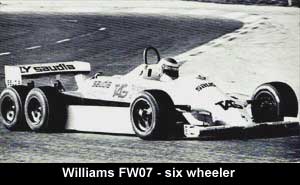 A few weeks ago, Autosport ran a nice piece on 'F1 cars that never raced', which included the Williams six-wheeler. Whilst the Tyrrell P34 of 1976 famously pioneered the idea of six wheels on a Formula 1 car, the Tyrrell employed four small wheels at the front, and, given that the rear wheels on a 1970s Formula 1 car were much bigger than the fronts, this failed to reduce the frontal area of the car. In contrast, the Williams six-wheelers of 1981 and 1982 had four driven wheels at the rear. This reduced frontal area, and, by virtue of splitting the torque amongst the contact patches of four tyres, rather than two, improved traction into the bargain.
The Williams FWo7s of 1979-1981 were, to my mind, the most beautiful of Formula 1 cars. They were simple, effective, and elegant. Scalextric duly brought out a model of the Fw07, one instance of which enjoyed many happy hours hurtling around my own 'figure-of-eight' track, clattering along the plastic armco, the aroma of over-heating electric motors diffusing through the air of the dining room.
By good fortune, I stumbled across this article on the internet today, in which an enthusiast describes how he converted a conventional Scalextric FW07 into a six-wheeled version. The casual ingenuity of this type of thing is fantastic:
p097.ezboard.com/fslotcarouthouse93633frm37.showMessage?topicID=15.topic

Thursday, January 25, 2007
The arrival of winter
From Sunday evening of this week, the weather forecasts predicted 'a widespread risk of snow and ice' in the South of England. The snow duly arrived on Tuesday night, but only in Sussex and Kent, where it normally seems to fall. At no stage did I hear or see a forecast which was willing to specify the counties in which the snowfall could be expected. This is exactly the type of information that commuters desire, and its absence is puzzling because the Met Office claims that its 3-day weather forecasts are now as accurate as their 1-day forecasts were 20 years ago. Perhaps the overall accuracy the Met Office claims for its forecasts is skewed by the accuracy of the forecasts issued under inherently predictable conditions, such as a 'blocking' high (pressure zone) during the summer or winter.
This week's New Scientist contains an article on the verification of weather forecast accuracy (27 January 2007, p32-35), which claims that forecasters at the Met Office receive an annual bonus determined by the verification scores for their forecasts. The article points out that forecasters can improve their scores by hedging, and by blurring the specifics of their forecasts. This perplexes me on two counts: firstly, that forecasters should be incentivized to make their forecasts less specific; and secondly, the very notion that the accuracy of a forecast is still dependent upon the forecaster producing it, seems to contradict the impression which the Met Office tries to convey about its prediction methodology. Atmospheric and oceanic data from weather stations and satellites are fed into meteorological models as initial conditions, and the Met Office supercomputers then predict the evolution of the meteorological parameters. In principle, making a forecast should then involve nothing more than reading off the predicted temperatures, pressures, cloudcover, and rainfall from these simulations, and translating them into a digestible package for the public. However, the very fact that forecasters receive bonuses based upon the accuracy of their forecasts suggests that there is actually still a large discretionary element to the production of a forecast. Perhaps one needs to have a good understanding of the idealisations and assumptions which have been incorporated into the atmospheric models if one is to judge the reliability of their predictions; there are a variety of atmospheric models, and perhaps the skill comes from understanding the circumstances in which each model is reliable or unreliable.
This week's New Scientist contains an article on the verification of weather forecast accuracy (27 January 2007, p32-35), which claims that forecasters at the Met Office receive an annual bonus determined by the verification scores for their forecasts. The article points out that forecasters can improve their scores by hedging, and by blurring the specifics of their forecasts. This perplexes me on two counts: firstly, that forecasters should be incentivized to make their forecasts less specific; and secondly, the very notion that the accuracy of a forecast is still dependent upon the forecaster producing it, seems to contradict the impression which the Met Office tries to convey about its prediction methodology. Atmospheric and oceanic data from weather stations and satellites are fed into meteorological models as initial conditions, and the Met Office supercomputers then predict the evolution of the meteorological parameters. In principle, making a forecast should then involve nothing more than reading off the predicted temperatures, pressures, cloudcover, and rainfall from these simulations, and translating them into a digestible package for the public. However, the very fact that forecasters receive bonuses based upon the accuracy of their forecasts suggests that there is actually still a large discretionary element to the production of a forecast. Perhaps one needs to have a good understanding of the idealisations and assumptions which have been incorporated into the atmospheric models if one is to judge the reliability of their predictions; there are a variety of atmospheric models, and perhaps the skill comes from understanding the circumstances in which each model is reliable or unreliable.
Tuesday, January 23, 2007
Companies are psychopaths
There's been something of a brouhaha in the UK this week over the scavenging of ship-wrecked goods from Branscombe beach. A cargo ship, the MSC Napoli, transporting approximately 2,400 containers, was deliberately grounded in Lyme Bay after suffering a 'structural failure' in last Thursday's storms. A number of the containers and their contents have been washed-up on the beach, and various goods, including BMW bikes, have been half-inched by happy middle-class beach-combers.
Whilst the authorities have accused such individuals of unmitigated greed, I think the action of the scavengers is largely justified. In radio phone-ins this morning, members of the public seemed to generally agree that it was wrong to take the property owned by individuals, but the property owned by companies was fair game. As one individual said, "companies screw us most of the time, so why shouldn't we screw them for once?" Quite.
This reminded me of the fact that companies, if treated as people, would be considered psychopathic. A company is totally selfish, has no conscience, feels no compulsion to speak the truth, and acts to destroy other companies. Those companies who pretend to be moral or environmental, try to promote these 'brand-values' as a calculated means to furthering the selfish interests of the company. Just recently, a delivery man from Amtrak broke my letterbox clean off. I've written to the local Amtrak depot manager, and even the chief executive, seeking some compensation. Needless to say, because Amtrak know that they can get away without doing anything, that's exactly what they do. People who work for companies often feel under no obligation to think morally, and consider that they are merely following 'company policy'. Rather like soldiers in wartime are merely 'following orders'.
In our current capitalist liberal democracy, government legislation should, in theory, act to constrain the power of companies, but it's a difficult balance to strike when the population desires economic growth. Is there an alternative political-economic structure to the 'companies plus government' structure? We know that a communist society, in which the 'means of production' are owned by the government, is a completely dysfunctional society, so this is not a viable alternative. Is there, however, a hybrid unit of structure, a combination of company and government, from which a better society could be built?
Whilst the authorities have accused such individuals of unmitigated greed, I think the action of the scavengers is largely justified. In radio phone-ins this morning, members of the public seemed to generally agree that it was wrong to take the property owned by individuals, but the property owned by companies was fair game. As one individual said, "companies screw us most of the time, so why shouldn't we screw them for once?" Quite.
This reminded me of the fact that companies, if treated as people, would be considered psychopathic. A company is totally selfish, has no conscience, feels no compulsion to speak the truth, and acts to destroy other companies. Those companies who pretend to be moral or environmental, try to promote these 'brand-values' as a calculated means to furthering the selfish interests of the company. Just recently, a delivery man from Amtrak broke my letterbox clean off. I've written to the local Amtrak depot manager, and even the chief executive, seeking some compensation. Needless to say, because Amtrak know that they can get away without doing anything, that's exactly what they do. People who work for companies often feel under no obligation to think morally, and consider that they are merely following 'company policy'. Rather like soldiers in wartime are merely 'following orders'.
In our current capitalist liberal democracy, government legislation should, in theory, act to constrain the power of companies, but it's a difficult balance to strike when the population desires economic growth. Is there an alternative political-economic structure to the 'companies plus government' structure? We know that a communist society, in which the 'means of production' are owned by the government, is a completely dysfunctional society, so this is not a viable alternative. Is there, however, a hybrid unit of structure, a combination of company and government, from which a better society could be built?
Monday, January 22, 2007
Encyclopedias and handbooks
For those who like their academic books large and compendious, a couple of interesting works have been published in the past year. Firstly, we have the 'Philosophy of physics' incarnation of the multi-volume 'Handbook of the philosophy of science'. This two-volume, 1522 page work is edited by Jeremy Butterfield and John Earman, published by Elsevier, and reasonably priced at £125.
Also of interest is the 'Encyclopedia of mathematical physics', edited by J.-P. Francoise, G. Naber & Tsou Sheung Tsun, and published by the Academic Press imprint of Elsevier. This five-volume work comprises 3500 pages, and will make an £855 hole in your bank account.
As usual these days, many of the articles are freely available as electronic pre-prints. Of particular interest are Martin Bojowald's account of Quantum Cosmology, arxiv.org/PS_cache/gr-qc/pdf/0603/0603110.pdf, (and note Bojowald's excellent choice of references!); George Ellis's 'Issues in the philosophy of cosmology', arxiv.org/PS_cache/astro-ph/pdf/0602/0602280.pdf; and NP Landsman's huge survey 'Between classical and quantum', philsci-archive.pitt.edu/archive/00002328/01/handbook.pdf.
Also of interest is the 'Encyclopedia of mathematical physics', edited by J.-P. Francoise, G. Naber & Tsou Sheung Tsun, and published by the Academic Press imprint of Elsevier. This five-volume work comprises 3500 pages, and will make an £855 hole in your bank account.
As usual these days, many of the articles are freely available as electronic pre-prints. Of particular interest are Martin Bojowald's account of Quantum Cosmology, arxiv.org/PS_cache/gr-qc/pdf/0603/0603110.pdf, (and note Bojowald's excellent choice of references!); George Ellis's 'Issues in the philosophy of cosmology', arxiv.org/PS_cache/astro-ph/pdf/0602/0602280.pdf; and NP Landsman's huge survey 'Between classical and quantum', philsci-archive.pitt.edu/archive/00002328/01/handbook.pdf.
Sunday, January 21, 2007
The Earth
I saw Eternity the other night,
Like a great ring of pure and endless light.
So said the poet Henry Vaughan, a short time, presumably, after ingesting some dubious herbal substance. Eternity, however, is rather passe, so I tried the other night to imagine the whole of the Earth as a unified active system:
Tectonic plates grinding rock together with geologic patience and continental force; a global geomorphological system of erosion, transportation and deposition; water percolating through soil and rock in dark, claustrophobic, subterranean solitude; hydrological networks of foaming mountain cataracts, and streams, and sedate, waltz-inspiring rivers, pumping water into the oceans; differential heating of the atmosphere generating pressure and temperature differences which dissipate via storms, depressions and jet streams; ocean currents, waves and tides; patterns of genes rippling amongst the biological species; cycles of agricultural land use; a vast network of villages, towns and cities, joined by road, rail, and river; a network of water supply and sewerage tunnels and pipes; an international network of oil and gas pipelines, suffuse with hydrocarbons; an electricity network of pylons, lines, cables, power stations and sub-stations, surging with potency; a telecommunications network of trunk lines, local exchanges, land lines, undersea cables and microwaves, linked to a constellation of satellites in orbit; a network of ports and shipping lanes across the oceans; a network of airports and airways puncturing the atmosphere; an economic system with prodigious flows of capital between accounts, assets, shares and derivatives; and an exponential system of information, memes and knowledge, supervening upon the genetic systems.
This is difficult to imagine, all at the same time.
Like a great ring of pure and endless light.
So said the poet Henry Vaughan, a short time, presumably, after ingesting some dubious herbal substance. Eternity, however, is rather passe, so I tried the other night to imagine the whole of the Earth as a unified active system:
Tectonic plates grinding rock together with geologic patience and continental force; a global geomorphological system of erosion, transportation and deposition; water percolating through soil and rock in dark, claustrophobic, subterranean solitude; hydrological networks of foaming mountain cataracts, and streams, and sedate, waltz-inspiring rivers, pumping water into the oceans; differential heating of the atmosphere generating pressure and temperature differences which dissipate via storms, depressions and jet streams; ocean currents, waves and tides; patterns of genes rippling amongst the biological species; cycles of agricultural land use; a vast network of villages, towns and cities, joined by road, rail, and river; a network of water supply and sewerage tunnels and pipes; an international network of oil and gas pipelines, suffuse with hydrocarbons; an electricity network of pylons, lines, cables, power stations and sub-stations, surging with potency; a telecommunications network of trunk lines, local exchanges, land lines, undersea cables and microwaves, linked to a constellation of satellites in orbit; a network of ports and shipping lanes across the oceans; a network of airports and airways puncturing the atmosphere; an economic system with prodigious flows of capital between accounts, assets, shares and derivatives; and an exponential system of information, memes and knowledge, supervening upon the genetic systems.
This is difficult to imagine, all at the same time.
Saturday, January 20, 2007
Lauren Laverne
 The Culture Show returns tonight on BBC2, after a month's break, and Lauren Laverne will be presenting once more. Now, don't get me wrong, I like Lauren Laverne. She's very attractive, and she has one of those charming regional accents which, these days, functions as an instant passport to a job with the BBC. However, on this particular show I reckon she is, how shall I say, 'winging it'. Now, this is actually a subtle skill: whilst 'blagging it' involves a dexterous and extemporary use of words to conceal a lack of knowledge or truthfulness, winging it often requires one to judiciously remain silent, or to encourage other people to talk, in order to conceal a lack of knowledge or preparation.
Lauren is on reasonably firm ground with, say, pop music or popular cinema, but when she's chatting to the bloke with the double-barrelled name about some installation or exhibition, I don't really sense a great depth of interest. I sense that Lauren is simply passing through, en route to Saturday night TV on BBC1. Whereas Verity Sharp, I feel, is very much at her final destination.
Friday, January 19, 2007
"It's not cinéma vérité, it's film noir!"
Not for the first time tonight, I pondered how I can get onto Newsnight Review on BBC2. One of the panellists this week was an elegant American writer and academic, Sarah Churchwell, (news.bbc.co.uk/1/hi/programmes/newsnight/review/3542918.stm) who, whilst discussing the new Paul Verhoeven film, 'Black Book', uttered the memorable rejoinder which forms the title of this blog. This is the type of woman I'd like to meet. We'd become instantly entwined in an intense and tumultuous relationship, a drama which would unfold upon the canvas of numerous open-air cafes in various European cities, our conversation laced with politics and philosophy and passion.
But first, I need to get onto Newsnight Review. One possible route is to become an NME journalist for 10 years or so, and then to migrate onto television as a 'pithy opinion dispenser'. Whilst I would enjoy ripping into Coldplay albums, this would be something of a long campaign. Another possible route is to become a modern poet, in the style of Tom Paulin or Ekow Eshun. I quite liked Mr Paulin's style of withering criticism ("I've never seen anything so completely abysmal, and awful, and reprehensible, and downright rotten in my entire life!"). I reckon I need to get myself to some of those literary parties.
Perhaps I should make a show, in Dave Gorman style, about my attempts to get onto Newsnight Review. If this show were to be reviewed on Newsnight Review, that would indeed be uber-ironic.
But first, I need to get onto Newsnight Review. One possible route is to become an NME journalist for 10 years or so, and then to migrate onto television as a 'pithy opinion dispenser'. Whilst I would enjoy ripping into Coldplay albums, this would be something of a long campaign. Another possible route is to become a modern poet, in the style of Tom Paulin or Ekow Eshun. I quite liked Mr Paulin's style of withering criticism ("I've never seen anything so completely abysmal, and awful, and reprehensible, and downright rotten in my entire life!"). I reckon I need to get myself to some of those literary parties.
Perhaps I should make a show, in Dave Gorman style, about my attempts to get onto Newsnight Review. If this show were to be reviewed on Newsnight Review, that would indeed be uber-ironic.
Subscribe to:
Posts (Atom)