
A week or so ago, someone tried to use Wikipedia to coin a new word, 'wittertainment'. The entry began as follows:
Wittertainment is a term inspired by the ‘Good Doctor’ Mark Kermode's film reviews on Simon Mayo's BBC Radio Five Live show.
Suggested usage: “Wittertainment at its most wittertaining”
In a nutshell, Kermode...is provoked into ranting by the urbane and erudite, Mayo, a perfect foil for the discontemparily-coiffed (sic), Kermode.
Now, Wikipedia policy forbids the coining of new words, and requires the citing of sources, so the Wittertainment article was deleted (en.wikipedia.org/wiki/Wikipedia:Articles_for_deletion/Wittertainment). However, the Wittertainment entry was read out on last Friday's film review slot, and this fact was added to the Wikipedia entry prior to deletion. This means that the entry acquired a source, even if the origin of the source was circular. This begs the question of whether Wikipedia entries could be self-generating. If 'wittertainment' enters general usage because of the Wikipedia entry, then the entry will have to be restored, and will become a self-generating encyclopedia article.
Friday, February 09, 2007


Thursday, February 08, 2007
New Scientist and climate change
The cover article in this week's New Scientist (10th February 2007, p6-p9), written by Fred Pearce, complains that the latest IPCC report underestimates global climate change, and that "many legitimate findings have been frozen out," because "research deemed controversial, not fully quantified or not yet incorporated into climate models was excluded."
Given that the whole raison d'etre of the IPCC reports is to present a solid, consensually agreed analysis of climate change, this seems a perverse criticism to make. The main article concludes with a quote from Venkatchalam Ramaswamy, who found that his own fears failed to make it into the IPCC summary, and complains that "Anything qualitative rather than quantitative was knocked out...By and large where there was ambiguity or controversy, it didn't make it." Again, this increases rather than decreases my confidence in the IPCC report!
There is certainly new data on, for example, the melting of ice sheets, and it is right that this data is analysed and investigated further until ice sheet melting is properly understood, but an IPCC report is not the appropriate forum for speculative debate or the extrapolation of small data sets.
My confidence in the New Scientist article is further eroded by the main diagram, which is a version of the IPCC diagram on p21 of the 'Summary for Policymakers', showing the predicted global warming under various scenarios, according to the various global climate models. New Scientist appear to have annotated their version of the diagram in a manner which is, at best, misleading. They define the error bars down the right as 'Potential error to one standard deviation'. This seems to be a mis-interpretation of the IPCC diagram, in which the shading either side of the coloured lines in the graph "denotes the plus/minus one standard deviation range of individual model annual means...The gray bars at right indicate the best estimate (solid line within each bar) and the likely range assessed for the six SRES marker scenarios. The assessment of the best estimate and likely ranges in the gray bars includes the AOGCMs in the left part of the figure, as well as results from a hierarchy of independent models and observational constraints." The error bars down the right indicate the dispersion of temperature predictions produced by the different global climate models for each scenario; they are not standard deviations produced by individual models.
Given that the whole raison d'etre of the IPCC reports is to present a solid, consensually agreed analysis of climate change, this seems a perverse criticism to make. The main article concludes with a quote from Venkatchalam Ramaswamy, who found that his own fears failed to make it into the IPCC summary, and complains that "Anything qualitative rather than quantitative was knocked out...By and large where there was ambiguity or controversy, it didn't make it." Again, this increases rather than decreases my confidence in the IPCC report!
There is certainly new data on, for example, the melting of ice sheets, and it is right that this data is analysed and investigated further until ice sheet melting is properly understood, but an IPCC report is not the appropriate forum for speculative debate or the extrapolation of small data sets.
My confidence in the New Scientist article is further eroded by the main diagram, which is a version of the IPCC diagram on p21 of the 'Summary for Policymakers', showing the predicted global warming under various scenarios, according to the various global climate models. New Scientist appear to have annotated their version of the diagram in a manner which is, at best, misleading. They define the error bars down the right as 'Potential error to one standard deviation'. This seems to be a mis-interpretation of the IPCC diagram, in which the shading either side of the coloured lines in the graph "denotes the plus/minus one standard deviation range of individual model annual means...The gray bars at right indicate the best estimate (solid line within each bar) and the likely range assessed for the six SRES marker scenarios. The assessment of the best estimate and likely ranges in the gray bars includes the AOGCMs in the left part of the figure, as well as results from a hierarchy of independent models and observational constraints." The error bars down the right indicate the dispersion of temperature predictions produced by the different global climate models for each scenario; they are not standard deviations produced by individual models.
Wednesday, February 07, 2007
Snowflakes
 Tomorrow morning, I confidently expect to awake and find the elegant spires and haphazard Victorian rooftops of Dorchester, transformed by the silent fall of billions of snowflakes.
 An individual snowflake is itself an agglomeration of up to several hundred ice crystals, and a cubic foot of snow can contain roughly one billion crystals of ice. Conventional wisdom suggests that no two snowflakes are alike, but in the case of the simplest type of snowflake, this isn't actually true. According to Dr Karl Kruszelnicki:
In 1988, the scientist Nancy Knight (at the National Center for Atmospheric Research in Boulder, Colorado) was studying wispy high altitude cirrus clouds. Her research plane was collecting snowflakes on a chilled glass slide that was coated with a sticky oil. She found two identical (under a microscope, at least) snowflakes in a Wisconsin snowstorm.
As Dr Karl points out, these snowflakes were simply hexagonal prisms, rather than the more complex type of snowflake-crystal, which exhibit the classic six-fold spoked structure, seen in the picture above. And, as both Dr Karl and Kenneth G.Libbrecht of Caltech point out, if two such snowflakes are deemed alike, then they are only alike at the level of resolution provided by a microscope.
Tuesday, February 06, 2007
Snow joke
Warm and humid Atlantic air is about to collide with cold continental air over the British Isles, causing heavy snowfall through Wednesday night and into Thursday morning. As ever, the Met Office's supercomputer simulations are now so accurate that they are able to predict exactly where the snow will fall: "The band of heavy snow is most likely to affect southern Wales, the Midlands and central and southern England, including London." In other words, the snow might fall anywhere South of Northern England. In fact, the Met Office's supercomputers are so impressive that they would like members of the public, here
www.metoffice.gov.uk/weather/uk/observations/snowreport.html
to tell them where the snow has fallen, so that they can accurately describe where the snow has fallen, after it has fallen. As the blurb says, "Snow is forecast for certain areas during the next few days. Some places could well see significant falls of snow, but many of us will see very little as the distribution of snow can vary enormously from place to place." Hilarious.
www.metoffice.gov.uk/weather/uk/observations/snowreport.html
to tell them where the snow has fallen, so that they can accurately describe where the snow has fallen, after it has fallen. As the blurb says, "Snow is forecast for certain areas during the next few days. Some places could well see significant falls of snow, but many of us will see very little as the distribution of snow can vary enormously from place to place." Hilarious.
Rubber pavements
Rubber pavements, apparently, have already been introduced to parts of Shanghai and Chicago, and could be introduced en masse in Philadelphia:
news.yahoo.com/s/ap/20070205/ap_on_fe_st/rubber_sidewalks_1
The main advantage of a rubber pavement is that it is porous, and thereby allows rainwater to percolate through into the groundwater, minimising surface run-off. Rubber pavement also allows air to penetrate into the soil, enabling tree roots to breathe. When the area over tree roots is concreted, the roots become suffocated, and actually spasm upwards to break through the concrete.
The initial costs of laying rubber pavement are currently slightly greater than concrete pavement, but according to Philadelphia councilman Jim Kenney, interviewed on Radio 5's 'Up all Night', it lasts longer than concrete pavement, and can be made from the recycling of old car tyres, so ultimately provides a cost saving.
news.yahoo.com/s/ap/20070205/ap_on_fe_st/rubber_sidewalks_1
The main advantage of a rubber pavement is that it is porous, and thereby allows rainwater to percolate through into the groundwater, minimising surface run-off. Rubber pavement also allows air to penetrate into the soil, enabling tree roots to breathe. When the area over tree roots is concreted, the roots become suffocated, and actually spasm upwards to break through the concrete.
The initial costs of laying rubber pavement are currently slightly greater than concrete pavement, but according to Philadelphia councilman Jim Kenney, interviewed on Radio 5's 'Up all Night', it lasts longer than concrete pavement, and can be made from the recycling of old car tyres, so ultimately provides a cost saving.
Monday, February 05, 2007
The Armando Iannucci Shows
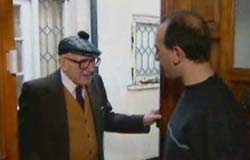 “When return of the Jedi came out, there were street parties. George V came out to see it, and we were all given a silver sixpence with a picture of Queen Victoria on one side and a picture of Jabba the Hutt on the other.” (Hugh.)
Armando Iannucci is well-known for satirical TV programmes such as 'The Day Today', 'The Thick of it', and, most recently, 'Time Trumpet'. However, his greatest work is his least well-known, 'The Armando Iannucci Shows', broadcast on Channel 4 in 2001. This series offered a much more personal, philosophy-of-life style of humour. You can sample a few clips here:
“There used to be air-raids and we’d all hide in the air-raid shelter and we’d watch television. And we always watched Don’t Forget Your Toothbrush with Chris Evans. He was very good, ‘til he disappeared up his own arse.” (Hugh).
Sunday, February 04, 2007
The space hosepipe
Now, you've all heard of the space elevator, a proposed structure anchored to the surface of the Earth, extending upwards through the atmosphere and into space? (en.wikipedia.org/wiki/Space_elevator) Well, now comes the space hosepipe, suggested by Jeremy Clarkson as a means of mitigating rising sea levels: www.timesonline.co.uk/newspaper/0,,176-2580397,00.html. Jeremy suggests that if we had a giant hose dipped into the sea at one end, and extending up into the vacuum of space at the other end, then the pressure difference would cause the water to be sucked up the pipe, against the force of gravity, and expelled into space. I haven't worked out if the pressure difference would be sufficient to overcome the force of gravity, but it's surely worth a go isn't it?
Saturday, February 03, 2007
Bullseye gives you flaps!
Coffee is for winners, go-getters, tea-ignorers, lunch-cancellers, early-risers, guilt-ridden strivers, money-obsessives and status-driven spiritually empty lunatics. It is an enervating force. We should resist it and embrace tea, the ancient drink of poets, philosophers and meditators. ('How to be Idle', Tom Hodgkinson, p98).
Whilst ruminating earlier today upon the beneficient properties of a cup of tea, I hit upon a wonderful business idea. The co-owner of Red Bull, Dietrich Mateschitz has made himself an awful lot of money by selling what is basically a carbonated sugary drink, with added caffeine. To market Red Bull, Mateschitz has associated the brand with various 'extreme' and adrenaline-fuelled activities such as Formula One, skydiving, aeroplane acrobatics, and snowboarding. This appeals, of course, to people who need above-average levels of stimulation to feel good. There is, however, another sub-population of people, for whom the average day at work provides more than enough stimulation, and who love nothing better than some rest and relaxation.
For these people, I will launch 'Bullseye', a carbonated sugary drink, with added tea. I will market the drink by associating it with activities such as: having a long soak in the bath; watching TV with your feet up; reading a good book or magazine; listening to the rain susurrating sibilantly upon the window pane; and dozing in bed, as the alpha brain-waves lap gently upon the shores of consciousness.
I will also market it with the slogan, 'Bullseye gives you flaps!' This is short and memorable, conveys the idea of slowing down one's speed of flight by deploying the wing-flaps, and also includes a vital adolescent double-entendre, which will have the media-types sniggering. It's pure marketing genius.
Whilst ruminating earlier today upon the beneficient properties of a cup of tea, I hit upon a wonderful business idea. The co-owner of Red Bull, Dietrich Mateschitz has made himself an awful lot of money by selling what is basically a carbonated sugary drink, with added caffeine. To market Red Bull, Mateschitz has associated the brand with various 'extreme' and adrenaline-fuelled activities such as Formula One, skydiving, aeroplane acrobatics, and snowboarding. This appeals, of course, to people who need above-average levels of stimulation to feel good. There is, however, another sub-population of people, for whom the average day at work provides more than enough stimulation, and who love nothing better than some rest and relaxation.
For these people, I will launch 'Bullseye', a carbonated sugary drink, with added tea. I will market the drink by associating it with activities such as: having a long soak in the bath; watching TV with your feet up; reading a good book or magazine; listening to the rain susurrating sibilantly upon the window pane; and dozing in bed, as the alpha brain-waves lap gently upon the shores of consciousness.
I will also market it with the slogan, 'Bullseye gives you flaps!' This is short and memorable, conveys the idea of slowing down one's speed of flight by deploying the wing-flaps, and also includes a vital adolescent double-entendre, which will have the media-types sniggering. It's pure marketing genius.
Friday, February 02, 2007
Fourth Assessment Report of the IPCC
 Well, it's arrived, and you can download the 'Summary for policymakers' here:
http://www.ipcc.ch/SPM2feb07.pdf
The key diagram is on the last page, p21. This shows the predicted evolution of global temperature over the course of the 21st century, for the six SRES 'marker' scenarios. By taking an average over the output of the various different global climate models, each differently coloured line represents the predicted evolution of global temperature under a particular scenario. Scenarios prefixed with an 'A' are scenarios in which economics are the driving factors, whereas scenarios prefixed with a 'B' are scenarios in which environmental policies are the driving factors. A1FI is the scenario in which fossil fuels continue to dominate global energy consumption, A1B is the scenario in which fossil fuels reach a balance with renewable energy sources, and A1T is the scenario in which there is a transition between fossil fuel usage and renewable energy.
The cost of solar energy is halving each decade, and solar energy is predicted to become a competitive rival to fossil fuel circa 2030-2040. Accordingly, the A1T scenario used in the third IPCC assessment report in 2001 represented CO2 emissions to decline beyond 2040. Assuming that economics will continue to be the driving factor, the two most realistic scenarios are therefore A1T and A1B. The scenario which produces the highest estimated rise in global temperatures, the A1FI scenario, is technologically and economically unrealistic, so the upper limits of the IPCC temperature range can be discarded.
The predicted temperature change under the A1T scenario averages out at 2.4 degrees C, with the various climate models producing a range of predictions between 1.4 and 3.8 degrees C. The predicted temperature change under the A1B scenario averages out at 2.8 degrees C, with the various climate models producing a range of predictions between 1.7 and 4.4 degrees C. In both cases the uncertainty is of the same order as the 'most likely' temperature change. There is still an awful lot of 'noise' being produced by the global climate models.
Thursday, February 01, 2007
Methane and contradictions
The February 2007 edition of Scientific American contains an article on plant-methane and climate change, written by Frank Keppler and Thomas Rockmann, the researchers who discovered a year or so ago that plants actually emit large quantities of methane, a significant greenhouse gas. Keppler and Rockmann calculate that plants and trees are responsible for somewhere between 10-40% of annual global emissions of methane. They also point out that plant methane emissions explain why atmospheric methane levels vary with the same pattern as atmospheric CO2 levels. In particular, warm, inter-glacial periods coincide with high levels of atmospheric CO2 in a manner that is reasonably well understood, but an explanation was sought for why such periods also have high levels of atmospheric methane. Keppler and Rockmann state that:
Extremely high atmospheric carbon dioxide concentrations as well as rising temperatures could have resulted in a dramatic increase in vegetation biomass. Such global warming periods could have been accompanied by a massive release of methane from vegetation and by more heating. (p44-45)
Vegetation then, and forests in particular, have a positive feedback effect upon global warming. If the temperature and CO2 increases, biomass increases, methane levels increase, and temperatures increase further. Keppler and Rockmann then state, however, that:
The climatic benefits gained by establishing new forests to absorb carbon dioxide would far exceed the relatively small negative effect of adding more methane to the atmosphere...The potential for reducing global warming by planting trees is most definitely positive. (p45).
This, I don't understand. At face value, it appears to be a direct contradiction. If increasing biomass increases global warming, then because reforestation increases biomass, reforestation must increase global warming. Perhaps the difference lies in biomass gained by the growth of existing trees and plants, versus the biomass gained by the planting of new trees. Perhaps the former results in a net gain of greenhouse gas, whilst the latter results in a net decrease. New trees increase the sequestration of carbon dioxide, perhaps, whilst tree and plant growth alone do not?
The authors argue that "the large plant [positive] feedback to global climate change that most likely happened in the past, however, is probably unlikely today because so many forests have been cut down," (p45). So if the only reason why plant-methane doesn't accelerate global warming today has been deforestation, this suggests, again, that reforestation would accelerate global warming. The claim that deforestation has hidden this positive-feeback effect itself deserves close scrutiny because global forest coverage has been largely constant since 1950, according to figures from the FAO (the Food and Agriculture Organization of the UN). 20% of the world's forests have been lost, but these losses mostly occurred prior to 1950 (approximately 2% has been lost since then). Global temperatures and CO2 levels have been rising since 1975, but the biomass of the Earth has remained largely constant during that period, so surely the positive feedback mechanism should have kicked in? Apparently not, given that atmospheric methane levels have remained largely constant since the 1980s.
Extremely high atmospheric carbon dioxide concentrations as well as rising temperatures could have resulted in a dramatic increase in vegetation biomass. Such global warming periods could have been accompanied by a massive release of methane from vegetation and by more heating. (p44-45)
Vegetation then, and forests in particular, have a positive feedback effect upon global warming. If the temperature and CO2 increases, biomass increases, methane levels increase, and temperatures increase further. Keppler and Rockmann then state, however, that:
The climatic benefits gained by establishing new forests to absorb carbon dioxide would far exceed the relatively small negative effect of adding more methane to the atmosphere...The potential for reducing global warming by planting trees is most definitely positive. (p45).
This, I don't understand. At face value, it appears to be a direct contradiction. If increasing biomass increases global warming, then because reforestation increases biomass, reforestation must increase global warming. Perhaps the difference lies in biomass gained by the growth of existing trees and plants, versus the biomass gained by the planting of new trees. Perhaps the former results in a net gain of greenhouse gas, whilst the latter results in a net decrease. New trees increase the sequestration of carbon dioxide, perhaps, whilst tree and plant growth alone do not?
The authors argue that "the large plant [positive] feedback to global climate change that most likely happened in the past, however, is probably unlikely today because so many forests have been cut down," (p45). So if the only reason why plant-methane doesn't accelerate global warming today has been deforestation, this suggests, again, that reforestation would accelerate global warming. The claim that deforestation has hidden this positive-feeback effect itself deserves close scrutiny because global forest coverage has been largely constant since 1950, according to figures from the FAO (the Food and Agriculture Organization of the UN). 20% of the world's forests have been lost, but these losses mostly occurred prior to 1950 (approximately 2% has been lost since then). Global temperatures and CO2 levels have been rising since 1975, but the biomass of the Earth has remained largely constant during that period, so surely the positive feedback mechanism should have kicked in? Apparently not, given that atmospheric methane levels have remained largely constant since the 1980s.
Subscribe to:
Posts (Atom)